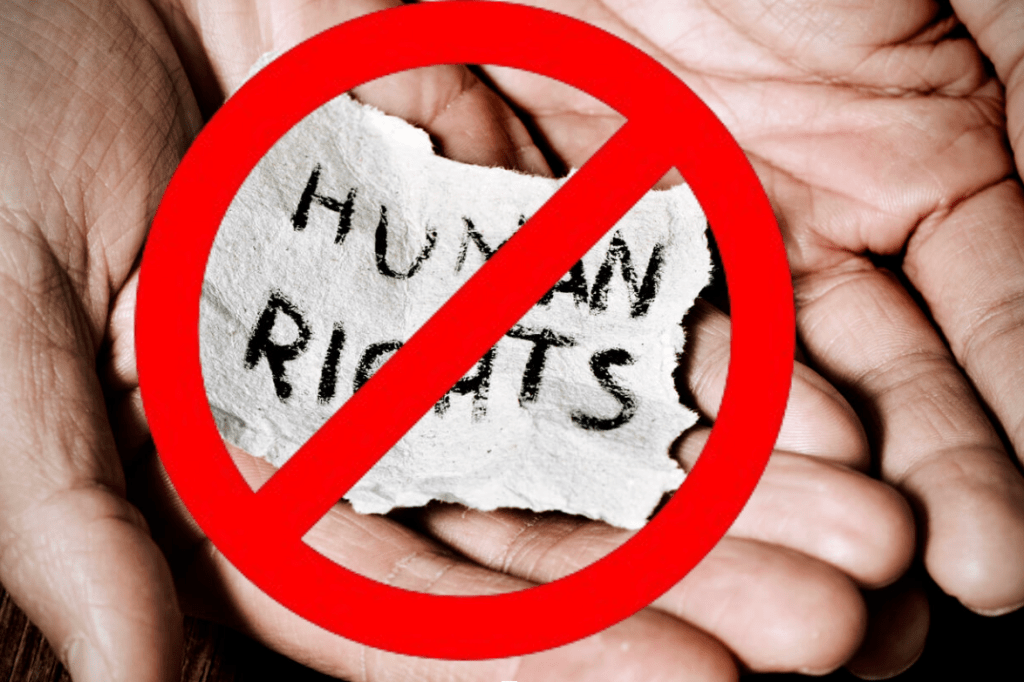
“Human-rights” do not exist, although I wish they did. To decry “human-rights violations” is therefore misleading and counterproductive, and we should change our language.
Rights are entitlements— they are owed, and they need mechanisms to ensure they are enforced. Without a mechanism to enforce it, to speak of a “right” is improper: you more likely have a desire, or an interest. For example, although most of us wish that we could all lead happy lives, there’s no talk of “a human-right to lead a happy life”, because it would be impossible to guarantee, and, accordingly, there would be no-one and nothing to hold accountable when it should fail. For a second example, think about cars. Although most people would desire a car, there is no “human-right to cars”. That might seem obvious to say, to the point of being inflammatory– you might think, “as if you’re comparing the right to a car to the right to be free from discrimination, or torture”. Except that these two things are actually similar in the way that is important. Just like not everyone is free from discrimination (to say the least), equally not everyone has access to a car. And in both these cases, there is no international or non-governmental system effectively moving to avenge that. To set one’s aim as upholding human rights can not be taken to be the same thing as actually upholding human rights, which inter-govenmental and non-governmental organisations fail to do. The United Nations, for example, has acheived nothing that could lend credit to claim that instances of discrimination are exceptions to a usually functional system. In some countries, some “human-rights” are protected in particular ways, but these rights are domestic rights only. They are not applicable to the citizens of other countries, and are therefore not universal, not “human”.
Iran is a state which for at least fifty years has been blatantly discriminatory, where free expression is suppressed, and where the government is brutally violent towards its own people. Has humanity assembled into a voltron-like superorganism to slam the Iranian oppresors with the righteous fist of justice? Not even close. The most consequential reponse that has been mustered so far has been the United States’ unilateral decision (well, made in conjunction with Israel) to bomb Iran (allegedly, but not actually, for humanitarian reasons), and the clearest impact of that bombing so far has been the deaths of nearly 200 schoolgirls in one day. That most righteous U.S. response took nearly 50 years to build up to; and, the people responsible for the deaths of those schoolgirls will probably never go to jail. This example is the rule, not the exception. How can we look at this case, and so many similar ones and pretend that there is anything even resembling a useful international legal system.
It may feel unjust to criticise so harshly an international system that has been built up by the earnest labour of so many good people, but it would do a greater disservice to its mission to pretend that it has succeeded.
But is it actually harmful to refer to “human-rights”, irrespective of whether they actually exist? Surely the difference between “human-rights” and “things that we believe all people should have” is small enough as to be insignificant; and surely I could never expect the latter label to be catchy enough for the headlines? Well:
This critique is not supposed to undermine the goals that “human-rights” law was developed to pursure: I firmly believe that the world would be a better place if all of the rights outlined in the UDHR were universally enforced; thus, I believe that language that we use when we discuss humanitarian crises and triumphs should be chosen to best advance that cause. Speaking in terms of “human-rights” and “human-rights violations” does not do this: we need to remember that “human-rights” do not truly exist, and our habitual reference to gives a false impression that they do. It gives the impression that the United Nations, whose reputation and identity is closely tied with that of “human-rights” law, is more good, effective, useful, than what it actually is. Secondly, “human-rights” language is fundamentally unmoving— it is terrible propaganda. It reduces death, trauma, oppression and suffering to “violations” of a “right”. It legalises and it obfuscates and it pretends that, to some extent, things are being sorted out, when in reality that legal system is a mirage. It presents “violations” as exceptions to a existing system of “rights”, when in reality, that system is either unreal or inneffective to the point of irreality. It does not make us angry enough.
If we want to prevent people from being killed, tortured, and hate-crimed, we need to describe reality. “Human-rights” do not exist for the people who need them: Iranian schoolgirls are being bombed; Iranian protestors are being shot in the streets; there is genocide, and murder in Ghaza; and Aboriginal people in Australia continue to be murdered in custody, systematically oppressed. To speak of these abuses as “human-rights violations” cools down the heat of our outrage, and implicitly validates the dubious “international order”, which in its current form of next-to-non-existence, has not progressed at all towards human equality and peace.
 Zinger!
Leave a comment